
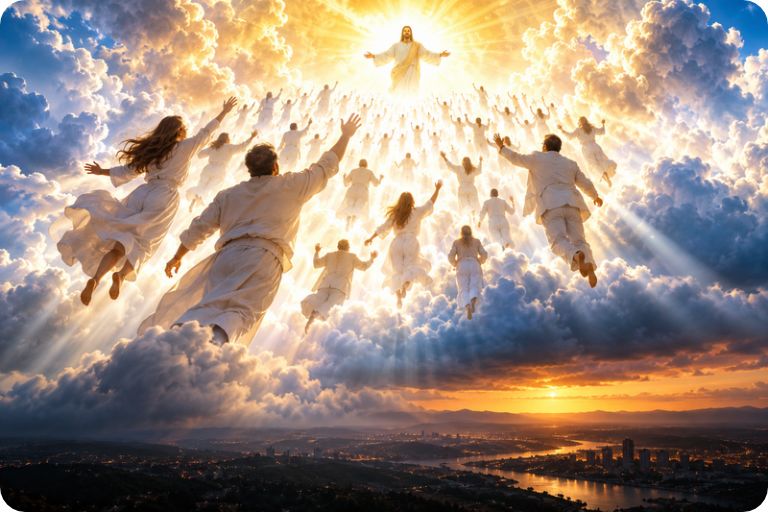
Throughout the Bible, a term frequently connected with the Second Coming of Christ is “the Day of the Lord.” It appears numerous times in Scripture, including passages such as Isaiah 2:10–12, Isaiah 34:1–10, and Joel 3:9–16. However, Bible readers will occasionally encounter another expression: “the Day of Christ.” Although the two expressions sound similar, are they describing exactly the same thing?
That question becomes especially important when we reach one of the most debated passages in Bible prophecy: 2 Thessalonians 2:1–3.
Paul writes:
“Now we beseech you, brethren, by the coming of our Lord Jesus Christ, and by our gathering together unto him, that ye be not soon shaken in mind, or be troubled, neither by spirit, nor by word, nor by letter as from us, as that the day of Christ is at hand. Let no man deceive you by any means: for that day shall not come, except there come a falling away first, and that man of sin be revealed, the son of perdition.”
At first glance, this passage seems to create a serious problem for the Pre-Tribulation Rapture position. Paul begins by speaking about “the coming of our Lord Jesus Christ” and “our gathering together unto him.” Furthermore, he speaks with urgency, using the word beseech.
Then comes the difficulty.
Paul tells these believers to not be troubled concerning “the day of Christ.” Afterward, he says that this day will not come until there is first a falling away and “that man of sin be revealed.”
How can that fit with a Pre-Tribulation Rapture?
Does “The Day of Christ” Really Mean “The Day of the Lord”?
For many teachers who hold to a Pre-Tribulation Rapture, the Man of Sin appearing before the Rapture seems impossible. Consequently, instead, they understand the expression in 2 Thessalonians 2:2 as referring to “the Day of the Lord.”
There is also a genuine textual issue here. The Textus Receptus underlying the King James Version reads “day of Christ,” while a number of other Greek witnesses read “day of the Lord.” Therefore, modern Bible translations commonly render the expression “the day of the Lord.”
Nevertheless, changing the expression does not make the larger interpretive problem disappear.
Why?
Because “our gathering together unto him” remains in the immediate context!
If Paul is talking about our gathering to Christ in verse 1, simply changing Day of Christ to Day of the Lord in verse 2 does not automatically explain the relationship between the gathering, the falling away, and the revealing of the Man of Sin. The passage can still be misconstrued as a Post-Tribulation Rapture passage.
Therefore, I believe we should seriously consider the wording “the Day of Christ.” Perhaps the passage is telling us something that many Pre-Tribulation believers have not considered.
Could the Church actually get a glimpse of the Man of Sin before we leave in a Pre-Tribulation Rapture?
I believe Scripture gives us reason to consider that possibility.
Revealed Does Not Mean Reigning
Before going further, an important distinction needs to be made.
Post-Tribulation Rapture proponents naturally point to 2 Thessalonians 2:1–3 because they believe the passage places the Rapture after the Antichrist has come to power. However, look carefully at what the passage actually says.
It does not say the Man of Sin must reign before our gathering to Christ.
It says he must be revealed.

Likewise, the passage does not say he has already received the crown pictured in Revelation 6:2. There is a considerable difference between seeing a man rising into prominence and seeing that man crowned and exercising his prophetic authority.
That distinction is essential to the interpretation I am presenting here.
I believe in a Pre-Tribulation Rapture. In fact, I recently dealt specifically with that subject in A Pre Trib Rapture? Weighing 3 Amazing Bible Passages! Yet believing in a Pre-Tribulation Rapture does not require me to believe that Christians know absolutely nothing about the Man of Sin before the Rapture occurs.
Furthermore, a Post-Tribulation interpretation creates another chronological problem. Scripture places the Judgment Seat of Christ and the marriage of the Lamb in connection with events involving the Church before Christ establishes His Millennial Kingdom on Earth. A Post-Tribulation scheme must therefore explain where these events fit once Christ has returned physically to Earth.
So, instead of beginning with a prophetic system and forcing this passage into it, let’s begin with the expression itself.
What does the Bible mean by “the Day of Christ”?
1 Corinthians 1:8 — Blameless in the Day of Christ
Paul tells the Corinthian believers:
“Who shall also confirm you unto the end, that ye may be blameless in the day of our Lord Jesus Christ.”
The surrounding passage, beginning in verse 4, commends the Corinthians for what God had given them in Christ. Paul then looks forward to their confirmation “unto the end” and blamelessness in “the day of our Lord Jesus Christ.”
Notice the direction of the passage. Paul is addressing Christians and looking forward to the completion of God’s work with them.
Therefore, the Day of Christ is not connected to God’s wrath being poured upon the nations. Instead, it is all about believers and their standing before Jesus Christ at the conclusion of the Church Age.
That distinction becomes even clearer in Philippians.
Philippians 1:6 — Until the Day of Jesus Christ
One of the best-known verses in Philippians says:
“Being confident of this very thing, that he which hath begun a good work in you will perform it until the day of Jesus Christ.”
God begins His work in the believer, and He continues that work “until the day of Jesus Christ.”
This verse is a wonderful statement concerning the security of the believer. Yet it also gives us another clue about the Day of Christ. Once again, the expression is associated with God’s work in Christians, not His judgment upon an unbelieving world.
The Christian’s earthly walk will eventually end, and the Church Age itself will reach its conclusion. Then comes our gathering to Christ and our appearance before Him.
That brings the Day of Christ into connection with both the Rapture and what follows it for the Christian—the Judgment Seat of Christ.
Philippians 1:10 — Sincere and Without Offence
Only a few verses later, Paul uses the expression again:
“That ye may approve things that are excellent; that ye may be sincere and without offence till the day of Christ.”
The context has not suddenly changed. Paul is still speaking to believers about their Christian walk.
His desire is that they remain sincere and without offence “till the day of Christ.”
Once again, the Day of Christ marks the destination toward which the Christian life is moving. Paul is not warning these believers about surviving Armageddon. Rather, he is concerned about how they will stand before Jesus Christ when their Christian race is finished.
Consequently, the expression continues to point us toward the conclusion of the Church Age and the believer’s appearance before Christ.
Philippians 2:16 — Rejoicing in the Day of Christ
Paul gives us another important reference in Philippians 2:16:
“Holding forth the word of life; that I may rejoice in the day of Christ, that I have not run in vain, neither laboured in vain.”
Why would Paul rejoice in the Day of Christ?
Because his Christian labor would then be evaluated.
Paul had preached the Gospel, taught believers, established churches, endured persecution, and spent his life serving Jesus Christ. He looked forward to the day when he would discover that his labor had “not [been] in vain.”
That fits beautifully with Paul’s teaching about the Judgment Seat of Christ in 1 Corinthians 3:11–15. God is not judging our salvation there; Christ has already paid for that completely. Rather, God is examining our works and service as Christians.
Paul also tells us in Romans 14:10 that “we shall all stand before the judgment seat of Christ.”
Therefore, this fourth reference reinforces what we have already seen. The Day of Christ concerns Christ and His Church at the completion of the Church Age.
And then we arrive at our problem passage.
2 Thessalonians 2:2 — The Day of Christ and the Man of Sin
Now reconsider 2 Thessalonians 2:1–3 in light of those other passages.
Paul begins with:
“the coming of our Lord Jesus Christ, and by our gathering together unto him.”
He then mentions:
“the day of Christ.”
Finally, he says:
“that day shall not come, except there come a falling away first, and that man of sin be revealed.”
If the other uses of Day of Christ point toward the culmination of God’s dealings with the Church, why should we automatically assign an entirely different meaning to the expression here?
Perhaps we shouldn’t.
Instead, the passage may be telling us that the Man of Sin may be revealed before the Church is gathered to Christ.
Again, notice the wording carefully. I am not saying that the leaders of the world have already crowned him. Neither am I saying that he has already begun his prophetic reign.
I am saying that we MAY see his revelation.
Is there anything elsewhere in Scripture that could support such a possibility?
Actually, I believe there is.
Revelation 3:10 and the Hour of Temptation
Prophecy teachers frequently use Revelation 3:10 as a proof text for the Pre-Tribulation Rapture:
“Because thou hast kept the word of my patience, I also will keep thee from the hour of temptation, which shall come upon all the world, to try them that dwell upon the earth.”
At first, that sounds like an excellent Pre-Tribulation Rapture verse. However, there is a problem.
Notice the condition:
“Because thou hast kept the word of my patience…”
If this promise were describing the Rapture of the entire Church, then it would appear that participation would depend upon Christians keeping the word. Yet the Rapture is not a reward earned through Christian faithfulness.
First Thessalonians 4:14 gives the qualification:
“For if we believe that Jesus died and rose again, even so them also which sleep in Jesus will God bring with him.”
The qualification is belief.
A Christian does not earn a place in the Rapture by reaching a particular level of obedience or spiritual maturity. We are saved by grace through faith, and our gathering to Christ rests upon what Jesus Christ has accomplished—not upon our ability to earn it.
So what is Revelation 3:10 describing?
Philadelphia, Laodicea, and What Comes Next
As I explain more fully in my free booklet, Seven Bible Prophecy Passages That Confuse Most Prophecy Students, I understand the seven churches of Revelation 2–3 not only as literal historical churches but also as prophetic pictures of successive periods of Church history.
Under that interpretation, Philadelphia represents approximately A.D. 1531–1881, while Laodicea represents the final period extending from approximately 1881 to the Rapture.
Philadelphia “kept the word.” Laodicea, by contrast, is characterized by lukewarmness, material prosperity, spiritual blindness, and self-satisfaction:
“Because thou sayest, I am rich, and increased with goods, and have need of nothing…” (Revelation 3:17).
Philadelphia also held to a King James Bible. Laodicea has generally spent time attacking it as a poor translation.
Consequently, I do not view the promise to Philadelphia in Revelation 3:10 as a blanket promise that every Christian will escape everything preceding the Tribulation.
Instead, I believe the Laodicean period—the period in which we presently live—will encounter what Scripture calls the “hour of temptation.”
I cannot develop that entire subject here. It deserves a lesson of its own. Nevertheless, I believe that hour connects with the events surrounding the revealing of the Man of Sin in 2 Thessalonians 2.
If so, something very important follows.
The next significant prophetic development involving the Church does not necessarily have to be the instantaneous Rapture with absolutely nothing recognizable preceding it.
The Church may first witness the revealing of the Man of Sin.
Not his crowning.
Not his full prophetic reign.
His revealing.
Does Matthew 13 Give Us Another Clue?
There is another passage that I believe deserves consideration: Matthew 13:24–30, the parable of the wheat and the tares.
Jesus describes a field in which an enemy sows tares among the wheat. Both grow together until the harvest. Then, at harvest time, something interesting happens.
God deals with the tares first.
Jesus says:
“Gather ye together first the tares, and bind them in bundles to burn them: but gather the wheat into my barn.”
Pay close attention to the wording.
The angels do not burn the tares immediately. Instead, they gather them into bundles “to burn them.” The burning is their eventual destination, but gathering and burning do not necessarily occur at the same instant.
I believe this may present a prophetic picture.
In this interpretation, the wheat pictures saved people, while the tares picture the unsaved who have existed alongside them during the Church Age. As the harvest approaches, the angels gather the tares first into identifiable bundles.
I believe those bundles may correspond prophetically to the ten kingdoms represented by the ten horns associated with the kingdom of the Man of Sin. If that interpretation is correct, the geopolitical structure connected with his future kingdom begins forming before the Lord gathers the wheat into the barn.
Then comes the gathering of the wheat.
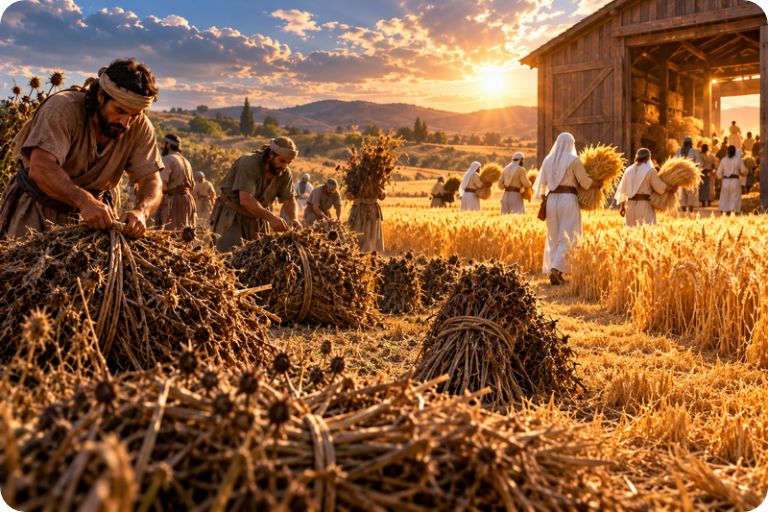
In other words, the Pre-Tribulation Rapture of the Church.
I want to be clear that the identification of these bundles with the ten kingdoms is an interpretation of the imagery; the parable itself does not explicitly identify them that way. Nevertheless, when we consider Matthew 13, alongside 2 Thessalonians 2, and the other prophetic passages we have examined, I believe the possibility deserves serious consideration.
So, What Is the Day of Christ?
When we compare these passages, a consistent pattern emerges.
The biblical references to the Day of Christ focus upon Christ’s relationship with His Church at the culmination of the Church Age. They point toward the completion of God’s work in believers, our gathering to Christ, and our subsequent standing before Him.
Consider the pattern:
1 Corinthians 1:8 — believers are to be blameless in the Day of our Lord Jesus Christ.
Philippians 1:6 — God’s work in believers continues until the Day of Jesus Christ.
In Philippians 1:10 — Christians are to remain sincere and without offence until the Day of Christ.
Philippians 2:16 — Paul expects to rejoice over his Christian labor in the Day of Christ.
2 Thessalonians 2:1–3 — scripture discusses our gathering to Christ in connection with the Day of Christ and the revealing of the Man of Sin.
Taken together, I believe these passages provide a strong biblical definition: the Day of Christ concerns the end of the Church Age, our gathering to Jesus Christ, and our standing before Him.
That makes the wording of 2 Thessalonians 2 extremely significant.
Revealed Before the Rapture—Not Reigning Before the Rapture
This distinction is the key to understanding my position.
Second Thessalonians 2 does not require us to place the Church under the Antichrist’s prophetic reign in order to take Paul’s words literally.
The revelation of the Man of Sin can happen before the Rapture without the world crowning him before the Rapture.
That interpretation allows us to take seriously Paul’s statement about the revelation of the Man of Sin while still maintaining a Pre-Tribulation gathering of the Church. Revelation 3:10 may provide another clue through the coming “hour of temptation,” while Matthew 13 may give us a picture of an end-time gathering taking place immediately before the Lord gathers the wheat into the barn.
Therefore, I do not believe Christians should assume that absolutely nothing prophetically significant can happen before the Rapture.
Something may happen first.
And if this interpretation is correct, the Church may be here long enough to recognize the rising figure Scripture calls “that man of sin, the son of perdition.”
One Final Thing Matters More Than Prophetic Timing
There is one danger in studying Bible prophecy that we should never overlook. We can become so interested in identifying the Antichrist that we fail to ask the most important question of all:
Do I belong to Jesus Christ?
The Gospel is not complicated. Jesus Christ died for our sins, was buried, and rose again according to the Scriptures (1 Corinthians 15:1–4). Salvation is not earned by keeping commandments, joining a church, understanding prophecy, or successfully identifying the Man of Sin.
It is received by faith in Jesus Christ.
Prophecy tells us where history is going. The Gospel determines where we are going.
So study the Day of Christ. Study the Man of Sin. Study the Rapture and the events that surround it.
But above everything else, make certain you know Christ Himself.
God bless you,
Brother Donnie – Founder of The End Time Classroom
Note: All images in this post are generated by AI.
Amen
Amen, brother!