

There is probably no subject in Bible prophecy that produces more argument among Christians than the timing of the Rapture. Some believe in a Pre-Trib Rapture. Others hold to a Mid-Tribulation position, a Pre-Wrath position, or a Post-Trib Rapture. Still others reject the idea of a Rapture altogether.
Consequently, many Bible students become overwhelmed by all of the arguments. They feel as though they must memorize every position, answer every objection, and understand every prophetic passage before they can know what they believe.
But that isn’t necessary.
The truth is, you don’t have to memorize every Rapture position and every argument in order to understand the biblical case for the Pre Trib Rapture. You don’t even have to win arguments. All that matters is you have peace, knowing the truth about this topic.
In this End Time Classroom Lesson, we are going to examine three powerful passages of Scripture that undeniably prove a Pre Trib Rapture. In fact, examining these passages in their proper sequence, we find a remarkably consistent picture.
I realize that calling them “undeniable proofs” may sound dogmatic to someone who holds another position. However, I ask only that you follow the Scriptures through to the end before reaching your conclusion. You may actually find that these passages challenge some assumptions you have heard about the Rapture.
So, let’s begin with the Book of Revelation.
1. Revelation 4–5: The Redeemed Watch From Heaven When the First Seal Opens
Our first proof centers on Revelation 5:1–9. However, to understand what John sees in Revelation 5, we should begin briefly in Revelation 4.
Revelation chapters 2 and 3 contain Christ’s messages to the seven churches of Asia Minor. Historically, these were seven literal churches. I also believe they prophetically picture seven successive periods of Church history, although that is a much larger study for another lesson. Significantly, after the messages to the churches conclude at the end of Revelation 3, chapter 4 begins with something that closely resembles a Rapture.
John writes:
“After this I looked, and, behold, a door was opened in heaven: and the first voice which I heard was as it were of a trumpet talking with me; which said, Come up hither…”
— Revelation 4:1
Notice the elements.
There is an open door in Heaven. Jesus described Himself as a door in John 10. There is a voice like a trumpet. John hears the words “Come up hither”—or, in modern English, “Come up here.” Immediately afterward, the Spirit takes John up, and he views Heaven.
The similarities to I Thessalonians 4:13–18 and I Corinthians 15:51–58, the two primary New Testament passages concerning the Rapture, are difficult to overlook. However, even if someone rejects that typological connection entirely, the argument does not depend upon it.
That is important.
John watches what is happening in Heaven before the Lamb opens the first seal. And what he sees there is remarkable.
What Does John See in Heaven?
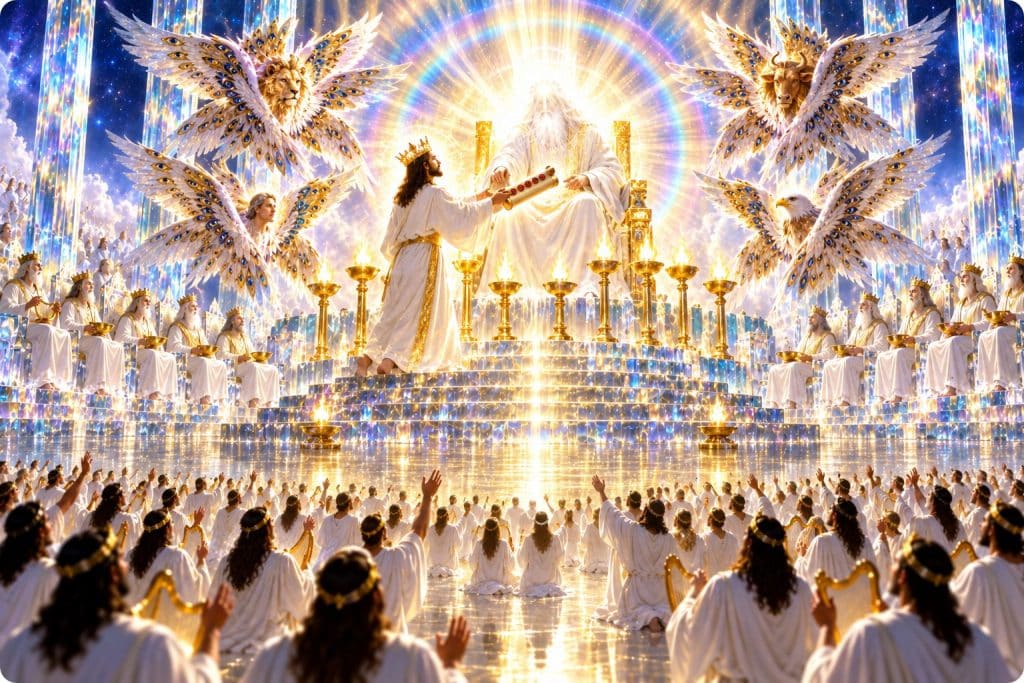
In Revelation chapters 4 and 5:
- John sees a throne and One seated upon it.
- He sees four beasts and twenty-four elders.
- He sees a seven-sealed book in the right hand of the One sitting upon the throne.
- He hears an angel ask who is worthy to open the book and loose its seals.
- No one is worthy to open the seals, and John begins to weep.
- One of the elders tells John that the Lion of the tribe of Judah has prevailed.
- John then sees Jesus Christ, the Lamb who died.
- The Lamb takes the book from the One sitting upon the throne.
- The four beasts and twenty-four elders fall before the Lamb.
- They have harps and golden vials full of the prayers of saints.
- Believers sing a song praising the Lamb for redemption through His blood.
Now notice something especially important.
The song speaks of redemption:
“…thou wast slain, and hast redeemed us to God by thy blood out of every kindred, and tongue, and people, and nation.”
— Revelation 5:9
That description identifies these redeemed people with believers from throughout the world.
They come from every kindred, tongue, people, and nation.
Furthermore, that fits perfectly with the New Testament description of the Body of Christ: believing Jews and Gentiles joined together in one body.
Ephesians 2:11–18 explains that Christ has made Jew and Gentile one. Ephesians 3:1–6 describes Gentiles as fellow heirs and members of the same body. Likewise, I Corinthians 12:12–13 says that the Holy Spirit baptizes believers into one body.
Therefore, the scene in Revelation 4–5 presents redeemed saints from among the nations already gathered in Heaven as the collective Body of Christ.
It’s clearly a Pre Trib Rapture!
But there is more.
They Already Have Their Crowns
Revelation 4:4 says that the twenty-four elders are wearing white raiment and have crowns of gold upon their heads.
That detail matters.
The New Testament links the believer’s crowns to rewards awarded after God judges the Christian’s service at the Judgment Seat of Christ. Paul discusses this judgment in 1 Corinthians 3:11–15 and Romans 14:10–12. Consequently, these people are the redeemed members of the Body of Christ.
They are in Heaven.
They are wearing white.
And they already possess crowns.
All of this is true before Jesus opens the first seal. Then something happens that is crucial to the timing of the Rapture.
The First Seal Is Opened
Revelation 6:1 begins:
“And I saw when the Lamb opened one of the seals…”
The first rider then appears upon a white horse. He receives a crown and goes forth conquering and to conquer.
I understand this rider to be the Man of Sin—(what some call the the Antichrist)—beginning his rise to worldwide power. But notice the sequence.
The redeemed are already in Heaven before the Lamb opens that seal.
Simply put, the Church does not arrive in Heaven after the Tribulation begins, in this sequence. The redeemed are already there, watching as Christ opens the book and begins the seal judgments.
That is enormously significant.
Furthermore, the Church disappears from the earthly narrative of Revelation during the Tribulation chapters and appears again in connection with Christ’s return in Revelation 19.
There we find the Bride prepared:
“And to her was granted that she should be arrayed in fine linen, clean and white…”
— Revelation 19:8
Then the armies of Heaven, clothed in fine linen, follow Christ out of Heaven when He returns. So…
How did the Bride get into Heaven before returning from Heaven with Christ?
Revelation 4–5 has already shown us. She was there before the first seal was opened. That is our first passage and the first proof!
But remarkably, the Old Testament gives us the same basic prophetic sequence through typology.
2. Genesis 22–31: The Son, the Bride, Israel, and the Tribulation
Genesis chapters 22 through 31 contain one of the most fascinating typological sequences in the Old Testament. Before examining it, however, we need to establish that biblical typology is a legitimate method of studying Scripture.
God Himself says:
“…I have also spoken by the prophets, and I have multiplied visions, and used similitudes, by the ministry of the prophets.”
— Hosea 12:10
Jesus also said:
“Search the scriptures; for in them ye think ye have eternal life: and they are they which testify of me.”
— John 5:39
Therefore, we should expect to find pictures of Christ throughout the Old Testament. And if the Old Testament speaks prophetically and typologically of Christ, we should not be surprised when it also contains pictures involving His Bride, Israel, and God’s prophetic program.
That is exactly what we find in Genesis.
Genesis 22: A Picture of the Cross
Genesis 22 contains the familiar account of Abraham offering Isaac. Abraham pictures the Father, while Isaac pictures the Son. God tells Abraham:
“…Take now thy son, thine only son Isaac, whom thou lovest…”
— Genesis 22:2
Several details point us toward Christ.
First, the sacrifice takes place in the land of Moriah. The name Moriah appears only one other time in Scripture, in II Chronicles 3:1, where Solomon begins building the Temple at Jerusalem upon Mount Moriah.
Therefore, Isaac is offered in the same general region where Christ would later be crucified.
Second, Abraham tells Isaac:
“…God will provide himself a lamb for a burnt offering…”
— Genesis 22:8
What remarkable wording. God would indeed provide the Lamb, but…
ULTIMATELY, God provided Himself in the Person of Jesus Christ.
Third, Abraham calls what they are about to do, “worship,” in Genesis 22:5.
And finally, a ram takes Isaac’s place upon the altar.
Hebrews 11:17–19 makes the typology even clearer. Abraham believed that God could raise Isaac from the dead and, Scripture says, received him back “in a figure.”
So Genesis 22 gives us a figure, similitude, and typology of the death and resurrection of the Son.
Then the story moves forward.
Genesis 23: Sarah Leaves the Scene
Immediately after the sacrifice of Isaac in Genesis 22, Sarah dies in Genesis 23. Within this prophetic picture, Sarah typifies Israel under the old covenant order. After Christ’s death, the New Testament was established.
Hebrews 9:16–17 tells us that a testament requires the death of the testator. Likewise, Ephesians 2:11–16 explains that through the Cross, Christ broke down the middle wall of partition and created one new body consisting of believing Jews and Gentiles.
However, God had not finished his prophetic program with Israel forever. Far from it.
God temporarily set Israel aside while he called out the Body of Christ.
And what happens immediately after Sarah leaves the scene?
The Father begins to seek a a bride for his son.
Genesis 24: A Bride for the Son
This is where the picture becomes extraordinary. Abraham sends his servant into another land to find a bride for Isaac.
In the typology:
Abraham pictures God the Father.
Isaac pictures Jesus Christ, the Son.
The servant pictures the Holy Spirit.
Rebekah pictures the Bride of Christ.
Notice some of the parallels.
The father sends his servant to obtain a bride for the son.
Likewise, during the Church Age, the Holy Spirit is working in this world calling people to Christ and forming the Body of Christ.
The servant also prays during his mission. Similarly, Romans 8:26–27 tells us that the Holy Spirit makes intercession for believers.
Furthermore, Abraham specifically commands that Isaac is not to return to the land where the servant is going.
Instead, the bride must go to the son.
That detail is fascinating when compared with the Rapture.
At the Rapture, Christ does not descend to establish His kingdom upon the earth. According to 1 Thessalonians 4:17, believers are:
“…caught up together with them in the clouds, to meet the Lord in the air…”
The Bride goes out to meet the Son.
Likewise, Rebekah must willingly respond to the invitation.
Genesis 24:58 records one of the simplest questions in the entire account:
“Wilt thou go with this man?”
And Rebekah answers:
“I will go.”
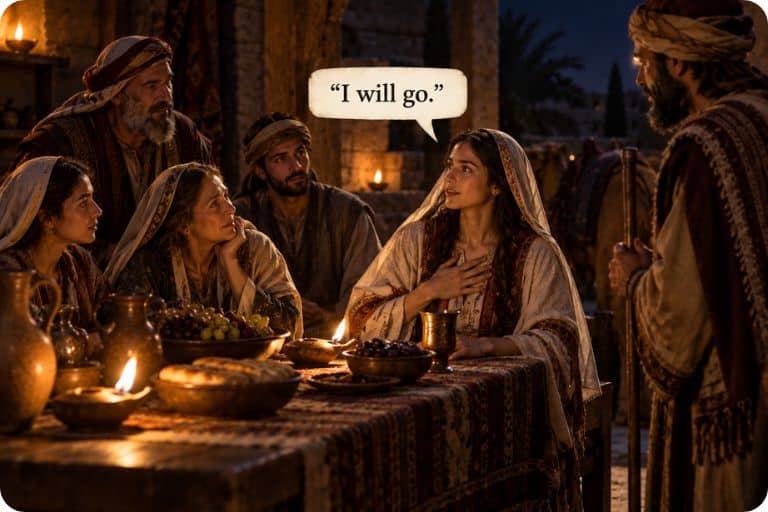
What a beautiful picture of salvation.
The servant gives the invitation, but Rebekah must respond.
She then journeys to meet a bridegroom whom she has never seen.
Likewise, Peter writes concerning Jesus Christ:
“Whom having not seen, ye love…”
— 1 Peter 1:8
Then Rebekah meets Isaac.
The servant brings the bride to the son.
But the prophetic picture continues.
Rebekah Disappears From the Narrative
Rebekah later gives birth to Jacob and Esau, and Jacob becomes central to the remainder of the story. Yet something unusual happens.
Rebekah simply disappears from the narrative.
Scripture records the deaths of Sarah, Rachel, Leah, and other major figures surrounding these chapters. However, Rebekah’s death is never recorded.
She simply vanishes from the story.
Typologically, that is exactly what happens to the Church.
The Bride is removed from the scene. And immediately afterward, the focus shifts back to Jacob—Israel.
That sequence is important.
Genesis 28–31: The Focus Returns to Jacob
Once Rebekah disappears from the narrative, Jacob becomes the central character. Jacob, of course, is later renamed Israel. He returns toward the land of his fathers.
Along the way, he sees a ladder reaching from earth to Heaven. Jesus Himself connects Jacob’s ladder with Himself in John 1:51.
Jacob also calls the place Bethel, meaning “house of God.” Then Jacob encounters Laban the Syrian, who deceives and oppresses him.
I believe Laban functions typologically as a picture of the Antichrist. Besides Laban deceiving Jacob, ultimately, Jacob must flee from him, just as Israel will flee from the Antichrist during the Tribulation, as pictured in Revelation 12.
Look at the overall sequence:
The Father sacrifices the Son
Sarah, representing a previous covenant order, moves out of the foreground.
The Father sends his servant to obtain a bride for the Son.
A Servant brings the bride to the Son.
The bride disappears from the narrative.
God’s attention returns to Jacob—Israel.
Jacob encounters a deceiver and eventually flees from him.
That sequence closely parallels the prophetic outline of the New Testament:
The Cross → the Church Age → the Rapture → God’s renewed dealings with Israel → the Tribulation.
Consequently, Genesis 22–31 provides an extraordinary Old Testament picture consistent with a Pre-Tribulation Rapture.
However, our third passage makes the picture even clearer.
3. Genesis 37–50: Joseph’s Gentile Bride Is With Him Before the Seven Bad Years
Our third proof comes from the life of Joseph.
Joseph is one of the clearest types of Jesus Christ anywhere in the Old Testament. There are scores of parallels between Joseph and Christ.
Consider just a few.
Joseph is rejected by his brethren.
His brethren are the sons of Israel who become the tribes of Israel.
They envy him.
They sell him for silver coins.
He becomes a servant.
He is falsely accused.
They place him in prison.
He later comes out of prison and is exalted.
His brethren believe him to be dead, but later discover that he is alive.
Eventually, those same brethren are reconciled to him.
And finally, Israel is brought into the land under Joseph’s protection.
The parallels with Christ are remarkable.
However, two additional details are especially important to our study of the Rapture.
Joseph takes a Gentile bride.
And:
His bride is with him before the seven years of famine begin.
That chronology is extremely important.
Seven Good Years and Seven Bad Years
Pharaoh dreams of seven years of great abundance followed by seven years of terrible famine. Joseph interprets the dream and is elevated to a position of tremendous authority in Egypt.
Genesis 41:41 records Pharaoh saying:
“See, I have set thee over all the land of Egypt.”
Joseph is exalted after his humiliation, just as Christ was exalted after His suffering.
Then Pharaoh gives Joseph a wife:
“And Pharaoh called Joseph’s name Zaphnath-paaneah; and he gave him to wife Asenath…”
— Genesis 41:45
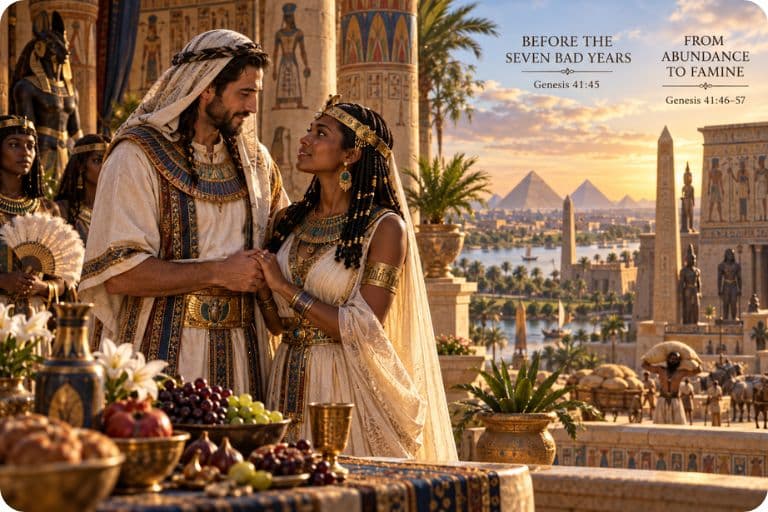
Joseph now has a Gentile bride. And notice when she becomes his bride.
She is with Joseph before the seven years of famine begin.
In fact, Genesis 41:50 specifically tells us that Joseph’s children are born:
“…before the years of famine came…”
Then the famine begins.
Meanwhile, Joseph’s brethren—the sons of Israel—enter the story during those terrible years.
They do not initially recognize Joseph.
Eventually, however, Joseph reveals himself to his brethren, and reconciliation takes place.
Once again, look at the sequence.
Joseph is rejected by his brethren.
Pharaoh exalts Joseph
Joseph receives a Gentile bride.
The bride is with him before the seven bad years begin.
During those years, Joseph deals with his brethren, Israel.
His brethren eventually recognize him.
Reconciliation follows.
Finally, Israel enters a time of peace and safety under Joseph’s rule.
The prophetic picture is difficult to miss.
Christ was rejected by His own nation.
During the present Church Age, God is calling out a Bride composed of believing Jews and Gentiles.
Before the seven-year Tribulation begins, the Bride is with Christ.
Then God’s prophetic dealings with Israel again come into the foreground.
During the Tribulation, Israel is brought to recognize her Messiah.
Finally, Christ returns and establishes His kingdom.
Therefore, Joseph’s story gives us essentially the same prophetic order we saw in Genesis 22–31.
And both agree with the scene John sees in Revelation 4–5.
Three Different Passages—One Consistent Sequence
Now put all three passages together.

Revelation 4–5, we see redeemed and crowned saints are already in Heaven before Christ opens the first seal.
Genesis 22–31, we see the Son is sacrificed, a Bride is obtained for the Son, the Bride disappears from the narrative, and God’s attention returns to Jacob—Israel—as he enters a period of deception and trouble.
Genesis 37–50, we see Joseph—the type of Christ—receives his Gentile bride before the seven terrible years begin. During those seven years, he deals with his brethren, and eventually they recognize him.
These are different books, different people, and different historical circumstances.
Yet the prophetic pattern remains remarkably consistent:
Christ’s sacrifice → the Church Age → the Bride with Christ → the Tribulation → Israel’s reconciliation → the Kingdom.
That is why I believe the Pre-Tribulation Rapture is not merely a theological system imposed upon Scripture.
It is a pattern that Scripture itself repeatedly presents.
Why This Matters
However, there is something more important than winning an argument about the timing of the Rapture.
You can understand every prophetic chart ever made and still miss the central Person of Bible prophecy.
Jesus Christ.
The Rapture is not ultimately about escaping trouble.
It is about Christ coming for His Bride.
And the most important question is not simply, “When will the Rapture happen?”
The most important question is:
Do you belong to Jesus Christ?
The same Christ pictured by Isaac and Joseph is the Lamb of Revelation—the One who was slain and redeemed sinners by His blood.
Jesus Christ died for our sins, was buried, and rose again.
Salvation is not earned through religion, good works, church membership, baptism, or our ability to understand Bible prophecy. It is received by grace through faith in Jesus Christ.
Rebekah was asked a simple question:
“Wilt thou go with this man?”
And she answered:
“I will go.”
There is a simplicity in that picture that we should never lose. As Paul said in II Corinthians 11:1-3.
The Bride belongs to the Bridegroom because she has responded to Him.
Therefore, while we study the signs of the times, the Tribulation, the Antichrist, and the Rapture, we must never allow prophecy to overshadow the Gospel.
Bible Prophecy Is Secondary To The Gospel
Bible prophecy should ultimately point us to Jesus Christ.
And for those who belong to Him, Paul gives us this wonderful promise:
“Then we which are alive and remain shall be caught up together with them in the clouds, to meet the Lord in the air: and so shall we ever be with the Lord.”
— 1 Thessalonians 4:17
And then Paul tells us exactly what we should do with that truth:
“Wherefore comfort one another with these words.”
— 1 Thessalonians 4:18
That is the blessed hope of the believer.
And that is why the Rapture should produce something very different from fear.
It should produce hope, comfort, and an expectation of seeing Jesus Christ.
It is my hope and prayer that this End Time Classroom Lesson has been a blessing to you.
Brother Donnie – Founder of The End Time Classroom
Note: All images in this post are generated by AI.
Amen
Amen, brother! You read it already! That’s good! I’m happy you enjoyed it.
Amen, yes! Wonderful revelation. God may continue reveal so much revelation for the servant’s like me. I’m trying to understanding the prophecy. God bless you
Amen, brother! So happy it is helping you! That’s a blessing to me. Is there anything in particular that you liked about this lesson?